
Early Bird: $15 (Up till 23 Feb 2026)
Standard: $20
NAF Group Bookings: $16 (Minimum 4 Tickets Purchased)
Ticket Pricing excludes Booking Fee. Booking Fee is as follows:
$6 booking fee per ticket for tickets above $60
$4 booking fee per ticket for tickets between $40.01 and $60
$3 booking fee per ticket for tickets between $20.01 and $40
$1 booking fee per ticket for tickets priced up to $20
Sessions:
31 March: 7.00 pm
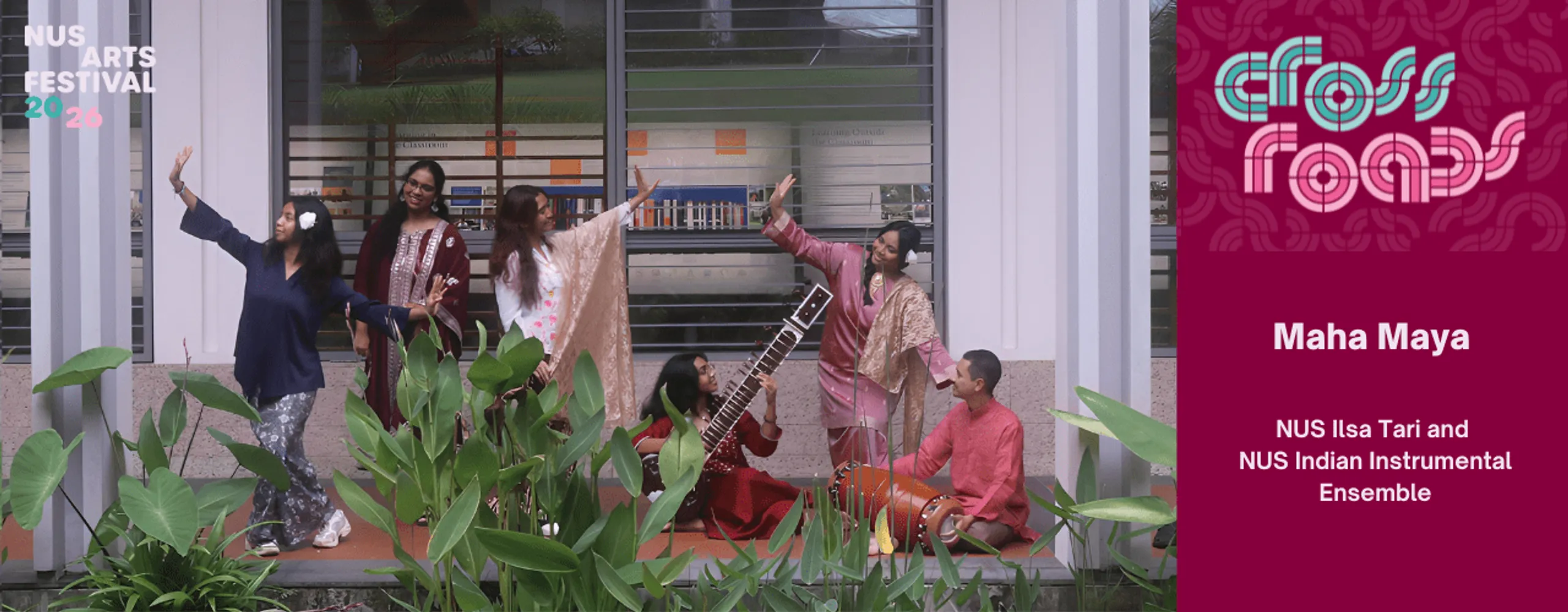
Maha Maya by NUS Ilsa Tari and NUS Indian Instrumental Ensemble explores the concept of blind justice through a textured dialogue between music and movement.
The production takes place in an idyllic utopia, where fractures caused by inequality and uncertainty quickly emerge. Faced with this, the protagonists must rely on a combination of ingenuity, courage, and heart to surmount these challenges and find peace once more. Featuring guest musicians from within the Malay community, Maha Maya is the first large-scale collaboration between the two groups.
Late Seating Policy
Latecomers cannot be admitted until an appropriate break in the show. For shows without an intermission, latecomers may risk being denied entry if there is no appropriate break in the show.
Admission of Children
All children require a purchased ticket for entry. As a courtesy to other audience members, infants in arms and prams, and children below six years of age cannot be admitted for ticketed shows.
Photography, Audio and Video Recording
Please refrain from using flash photography. Non-flash photo taking and video recording are welcome provided it does not obstruct the view or disturb the experience of others.
Access
The venue is wheelchair accessible. Please contact us at [email protected] if you have any access needs.
Advisory
This show may use theatrical haze, strobe lighting, coarse language and loud sounds. Viewer discretion is advised.
All information is correct at time of publishing but may be subject to change without prior notice.
The Promoter reserves the right to amend the above without prior notice. In the event of any dispute, the Promoter's decision is final.
NUS Ilsa Tari
Originally known as NUS Malay Dance Group under the direction of its founding tutor Mr Abdul Rahman Mawari, the group had their first performance at the NUS Welcome Convention in July 1986 at the NUS Forum. In May 1995, NUS Malay Dance Group was renamed NUS Ilsa Tari by its former Artistic Director and Resident Choreographer Osman Abdul Hamid.
The word ‘Ilsa’ is derived from the Malay word ‘Asli’ to mean native, signifying a bold new artistic direction for radical creativity in Malay Dance while acknowledging the importance of the past. Establishing strong foundations in traditional Malay Dance forms such as Zapin, Ronggeng, Inang and Serampang 12, together with the traditional Malay martial art of Silat, NUS Ilsa Tari experiments with both traditional and contemporary Malay Dance, pushing the boundaries of creativity and modernity. Today, NUS Ilsa Tari plays an important part in the evolution of Malay Dance forms relevant to our times through practice, discourse, performance and engagement with the next generation.
NUS Indian Instrumental Ensemble
Through the practice and performance of music rooted deep within Indian culture, the NUS Indian Instrumental Ensemble provides an open and inclusive environment to stage cultural dialogues with a diverse range of genres across the world.
Since its founding in 1987, IIE has explored a variety of themes that form the basis of traditional Indian music ranging from the evolution of music in the Indian sub-continent to religion and socio-political dialogues in the South Asian region.
With a large range of instruments, IIE is able to perform music that is representative of the ethnic diversity within India and at the same time experiment and explore fusion music. By blending Eastern and Western instrumentation and influences, IIE hopes that a bold new sound can be brought forth that reflects the vibrant identity of modern Asian youth today.
Dinie Dasuki Osman | Choreographer
Dinie is a Malay dance practitioner. He is a dance artist, choreographer, and instructor who is rooted in traditional dance and explores its contemporaries; intrigued by the moving body and the synergy between mind and body. Driven by tradition and the traditional form, he is curious about how movement relates to the state of mind.
Dinie has been under the tutelage of artistic director and choreographer Osman Abdul Hamid since the early 2000s and has trained with regional experts like Tom Ibnur, Ery Mefri, and Peter Selayan from Indonesia. As a leading member of Era Dance Theatre, Dinie takes on multiple roles including training, choreography, and conceptualization.
Dinie is also an arts educator and teaches various programmes including CCAs in schools. He holds a Specialist Diploma in Arts Education by National Institute of Education (NIE) International.
Hasyimah Harith | Choreographer
Hasyimah Harith is a Malay-Muslim female artist that performs, choreographs and teaches Malay folk dance. Using her body as the starting point, Hasyimah works with the Malay traditions and eroticism, as a way to reclaim agency over her body. Her working methods involve strategies of boosting libido such as fantasy and intimacy. Her works hope to confront and overcome the conditioned shame and grief that is often attached to female eroticism.
Hasyimah is one of the founders of P7:1SMA (pronounced as Prisma), a dance company formed in 2016 that believes dance is a strategy, and Malay is a concept. She is a trained Visual Arts educator who specialises in teaching how to create and appreciate Art. Since 2010, Hasyimah has contributed as a Malay dance instructor and choreographer at Azpirasi. She is an Artist-facilitator in the Performing Arts Faculty at ART:DIS.
Nawaz Mirajkar | Conductor
A tabla virtuoso, composer, collaborator, and educator, Nawaz Sir has been at the heart of Singapore’s music scene for over two decades. For the past 4 years, he has guided the NUS Indian Instrumental Ensemble (IIE), mentoring them in crafting original, award-winning productions and carrying Indian classical music into new horizons while staying rooted in tradition.
His contributions to the arts have been recognised with accolades such as the National Arts Council’s Young Artist Award (2011), the Kalashri Yuva Award (Pune, 2017), and the Pandit Deepak Chowdhury Memorial Award (Kolkata,
2020).